
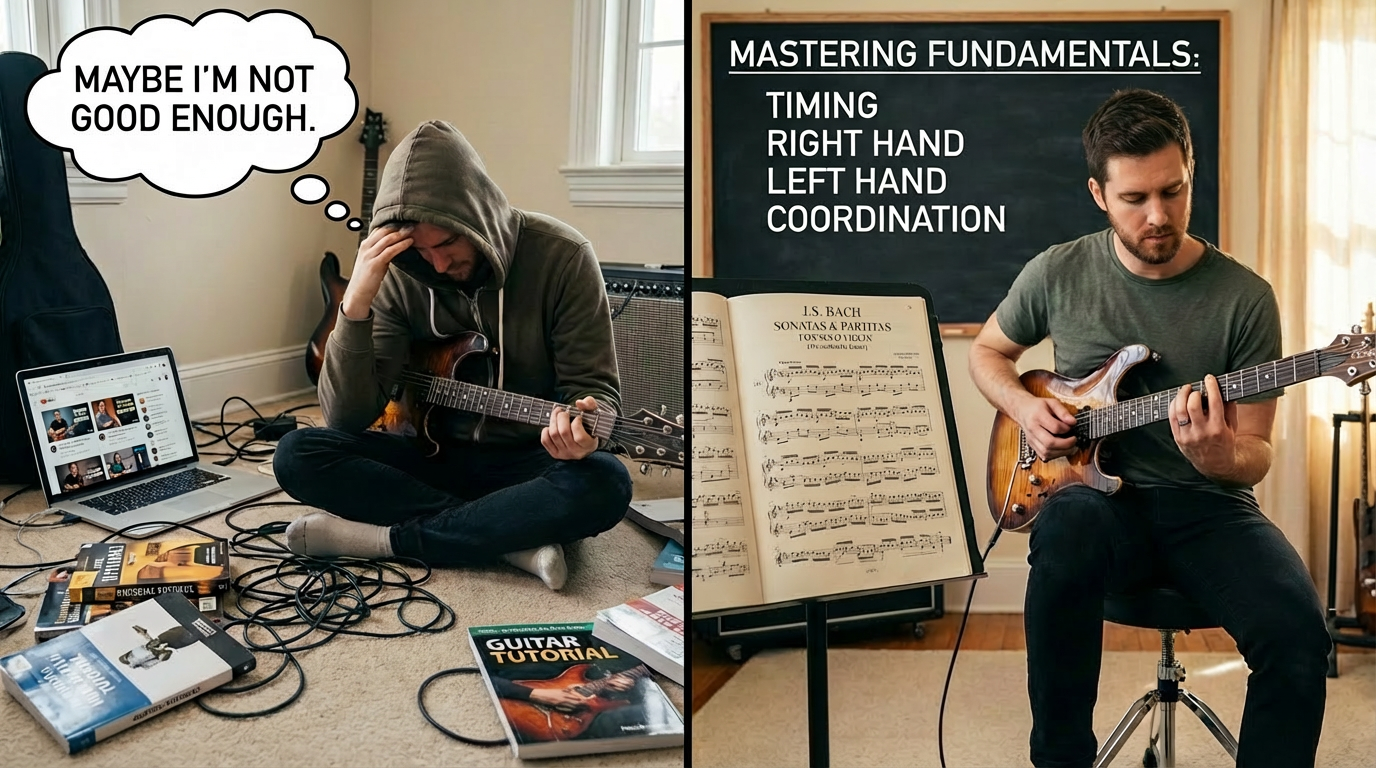

If you feel stuck on the guitar, you’re not alone.
Every guitarist reaches this point sooner or later:
- You practice but don’t really improve.
- Your fingers don’t obey.
- Chords buzz and never sound clean.
- Rhythm feels unstable and rushed.
- You jump from tutorial to tutorial… but nothing sticks.
After enough frustration, it’s easy to think:
“Maybe I’m just not talented enough.”
You’re not the problem.
Your guitar fundamentals are.
Most players skip foundational technique because they think it’s “too basic” or “for beginners only”.
In reality, it’s the core of everything: tone, speed, rhythm, improvisation, confidence — they all start with solid fundamentals.
This guide will show you what’s really holding you back and how to rebuild your technique in a clear, realistic way.
Why Your Guitar Playing Isn’t Improving
After years of teaching and playing, I see the same patterns in almost every frustrated guitarist.
1. Your right hand is doing too many things at once
The picking hand controls time, tone and articulation.
When pick angle, stroke direction and dynamics are random, your playing will always feel inconsistent.
Many students discover that they’ve been holding the pick in a way that fights their natural motion.
They try to play faster, but their mechanics are literally working against them.
2. Your left hand is wasting energy
You press too hard → tension builds → speed disappears.
- Your fingertips hurt early in the practice session.
- Barre chords feel impossible.
- Your hand gets tired long before your mind does.
This is not a strength problem; it’s a mechanics problem. With correct positioning, you need far less pressure than you think.
3. You practice in a chaotic way
Random YouTube lessons and Instagram licks do not add up to a technique system.
You might know a lot of fragments:
- one warm‑up here,
- a scale pattern there,
- a lick from a solo you like…
…but none of it is organized. You never stay long enough on one thing to let your hands truly adapt.
4. Nobody corrected your micro‑mistakes
Tiny technical errors, repeated every day, become huge obstacles:
- Collapsed finger joints
- Thumb wrapped too far over the neck
- Pick digging too deep into the string
- Notes slightly ahead or behind the beat
You can’t fix what you don’t notice. Practicing alone means you repeat the same mistake thousands of times.
The 4 Guitar Fundamentals You Must Master
Instead of chasing more and more exercises, focus on these four pillars.
They’re the foundation I use with students before we even talk about speed or advanced harmony.
1. Timing & Rhythm Control
Good rhythm is what separates “someone who plays guitar” from a musician.
Core rhythm fundamentals include:
- Feeling quarter notes, eighths and triplets in your body
- Keeping consistent downstrokes on simple patterns
- Placing accents on purpose, not by accident
- Treating the metronome as a groove partner, not as a police officer
When your time is strong, even a simple two‑chord progression can sound professional and musical.
Without rhythm, even fast scales sound messy.
2. Right‑Hand Technique: The Engine of Your Tone
Your right hand is where tone and clarity are born.
To master guitar fundamentals on this side, you need:
- Awareness of pick angle (too flat vs. too tilted)
- Control of rest stroke vs. free stroke
- Efficient down–up motion that doesn’t waste energy
- Dynamic control, from soft comping to aggressive accents
Often, a 2–3 mm change in where you pick, or how deep the pick goes into the string, can transform your sound immediately.
3. Left‑Hand Positioning: Maximum Result, Minimum Effort
Most players think they need more strength.
In reality, they need better leverage.
Left‑hand fundamentals include:
- Curved fingers landing on the very tips
- Thumb placement that supports the hand instead of squeezing
- Micro‑shifts between positions instead of big jumps
- Only using as much pressure as the note truly needs
When these elements are correct, chords ring clearly, legato feels smooth and stretches become possible without pain.
4. Coordination & Synchronization
Real speed doesn’t come from forcing your hands to move faster.
It comes from both hands moving together with zero hesitation.
To develop this:
- Start very slowly and focus on both hands landing at the exact same time
- Use simple patterns (even four notes) and repeat until they feel automatic
- Increase tempo only when you can play ten perfect repetitions in a row
If your hands are out of sync at 60 bpm, they will be twice as messy at 120 bpm.
Synchronization is the hidden secret behind “effortless” fast playing.
A Simple Daily Guitar Fundamentals Routine (10–20 Minutes)
You don’t need hours of practice.
You need focused, repeatable work on the right things.
Here’s a realistic routine you can use starting today:
Step 1 – Rhythm & Subdivision (5 minutes)
- Set a metronome at a comfortable tempo.
- Play muted strings or clap while cycling through:
- 4 quarter notes
- 8 eighth notes
- 12 triplets
Focus on staying relaxed and locked to the click. This trains your internal clock.
Step 2 – Right‑Hand Focus (5 minutes)
- Choose one string.
- Play down‑up strokes very slowly, watching your pick angle and depth.
- Aim for every note to have the same volume and tone.
You’re teaching your picking hand to move like a machine: efficient and predictable.
Step 3 – Left‑Hand Efficiency (5 minutes)
- Use a simple four‑finger pattern (1‑2‑3‑4 on each string).
- Keep your thumb light and your fingers curved.
- Experiment with the minimum pressure needed for a clean note.
If your forearm or hand tenses up, you’re pressing too hard.
Step 4 – Coordination (5 minutes)
- Combine both hands on a short pattern you already know.
- Start at a very slow tempo and listen for timing issues.
- Don’t increase the tempo until the pattern feels boringly easy.
Do this routine 5 days a week for a month and you’ll feel a clear difference:
cleaner sound, less tension and more confidence under your fingers.
Common Myths About Guitar Fundamentals
While working with students, I hear the same misconceptions over and over:
“Fundamentals are only for beginners.”
In reality, advanced players revisit fundamentals constantly.
Jazz and classical musicians spend years perfecting basic movements.
“Focusing on technique kills creativity.”
Bad technique kills creativity, because your hands can’t play what you hear.
Solid fundamentals actually free your musical ideas.
“I don’t need a metronome if I play with backing tracks.”
Backing tracks hide timing problems. A metronome exposes them — and that’s how you fix them.
Letting go of these myths is often the first real step toward better guitar playing.
How Strong Fundamentals Unlock Everything Else
When your guitar fundamentals are solid, everything becomes easier:
- Learning new songs takes less time because your hands obey.
- Improvising feels natural because your fingers know where to go.
- Recording or playing with other musicians stops being stressful.
- You enjoy practicing, because you can actually hear progress.
Instead of fighting your instrument, you finally feel like the guitar is working with you.
If You Want a Structured Way to Master Guitar Fundamentals
You can fix all of this alone, but it usually takes years of guessing, switching between random lessons and hoping something works.
That’s why I created Guitar Fundamentals – SoundCraft Method:
a step‑by‑step course designed specifically for guitarists who feel stuck and want to rebuild their technique from the ground up.
Inside the course you’ll get:
- A clear practice roadmap focused on essential guitar fundamentals
- Video breakdowns of right‑hand and left‑hand mechanics
- Progressive exercises for cleaner tone, stronger rhythm and better coordination
- Play‑along routines from 10 to 30 minutes so you always know what to practice
- Corrections for the most common micro‑mistakes I see in real students
It’s not just another list of “100 warm‑ups”.
It’s a coherent system based on years of teaching, studying modern guitar biomechanics and playing in real musical situations.
If you’re ready to stop spinning your wheels and finally feel in control of your playing, start by mastering your fundamentals.
From there, every style, riff and solo becomes easier — because your technique is finally on your side.